
Morgan County Parole and Probation
Parole and probation can both place a person in the community under rules, yet they begin in different ways. The Tennessee Board of Parole decides whether parole should be granted. Parole lets an eligible person leave confinement before the sentence expires, subject to an approved release plan and conditions. A grant is not the gate event. TDOC must still approve the plan and complete release processing.
Probation comes from a court sentence. It may begin without a prison term, or it may follow a period of split confinement. TDOC Community Supervision manages both state parole and felony probation in the community. Its Types of Release page says a probationer should report within 48 hours after placement or release from split confinement, but the judgment and the assigned officer's directions control.
| Point | Parole | Probation |
|---|---|---|
| Who authorizes it | Tennessee Board of Parole | Sentencing court |
| When it starts | After confinement and completed release steps | At sentencing or after split confinement |
| Who supervises | TDOC Community Supervision | TDOC Community Supervision for covered felony cases |
| Best public check | FOIL status plus Board record when needed | FOIL status plus judgment or supervision record |
- Parole
- Conditional community release before sentence expiration.
- Probation
- A court-ordered community sentence with stated conditions.
- Discharge
- The formal end of custody or supervision shown by the controlling record.
- Absconder
- A supervised person alleged to have stopped reporting or complying, often with enforcement action pending.
Verify Morgan County Post-Release Supervision
Tennessee FOIL is the public starting point for a person currently or formerly in TDOC custody or supervision. It covers state felony records, including people discharged from Morgan County Correctional Complex and people on TDOC parole or probation. It does not cover every person who spent time in Morgan County Jail. Search results may include a photograph, status, location, offense, sentence details, hearing status, and release information. Fields vary by record, so copy the exact label rather than turning every date into a release date.
- Classify the last known case. Use FOIL for a TDOC prison, parole, or felony-probation record. Use the court and MCSO for a county-jail-only case.
- Search FOIL by first and last name, with an alias or race if useful. A TDOC/TOMIS number or SID gives a more precise route. Complete the case-sensitive CAPTCHA.
- Compare stable identifiers before selecting a result. A similar name alone is not enough.
- Read the status exactly. “Parole,” “probation,” and “inactive” are not interchangeable. Note the lookup date, location, release information, and hearing status shown.
- Call the assigned TDOC office when the public status is unclear. Ask only for public confirmation and follow the officer's instructions.
- For a disputed parole decision, request the final Board order. Do not treat a hearing officer's recommendation as the Board's final action.
A VINE alert can prompt a recheck, but it is not a supervision certificate. Tennessee VINE reports custody events supplied by participating agencies. Morgan County Jail participation must be confirmed in the live system. For a full release history and county record path, use the Morgan County released-inmate search.
Morgan County Supervision Office
Morgan County is served regionally by TDOC District 21. The state directory groups Morgan with Anderson, Fentress, and Scott counties at the Clinton office. No official directory entry lists a Wartburg field office or a Morgan-specific walk-in method. The assigned officer may set a different reporting location or method, so calling before a visit is the sound course.
TDOC Community Supervision, District 21110 E. Centre Stage Business Park
Clinton, TN 37716
Phone: 865-220-4001
Fax: 865-463-7084
The TDOC field-office directory is the source for this regional assignment. A FOIL record showing supervision does not authorize an unplanned office visit. Contact the office, identify the record carefully, and ask how the person should communicate with the assigned officer.
The successful manifest image from the official TDOC directory records the District 21 listing used for Morgan County:
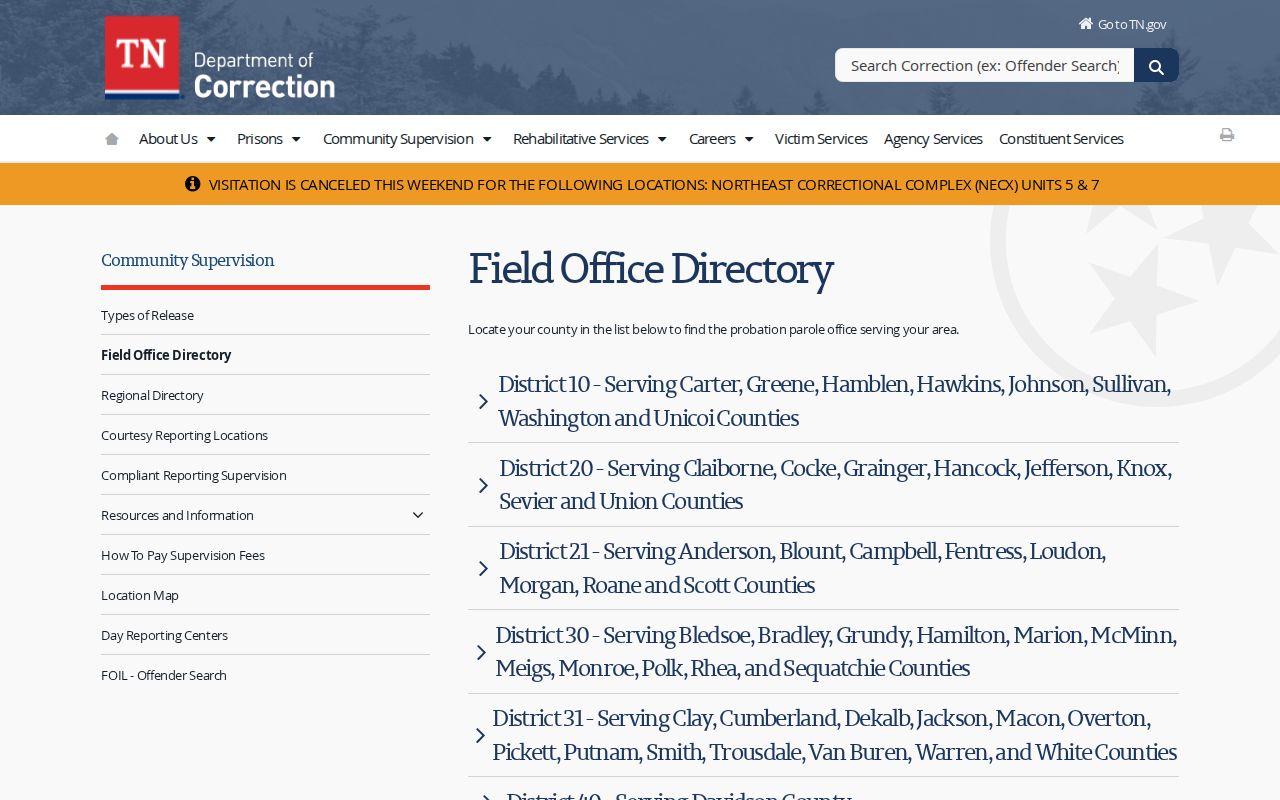
The directory supports the regional office route, while the assigned officer's current instructions still control an individual's reporting method.
Morgan County Supervision Violations
Conditions come from the judgment, Board order, release certificate, and officer instructions. They may require reports, approved residence, treatment or programs, travel permission, or other case-specific conduct. A public summary cannot replace those documents. Failure to comply can lead to a violation report, warrant, hearing, stricter conditions, or renewed confinement, depending on the authority and facts.
An absconder label is more than an ordinary release status. It generally alleges that a person left supervision or stopped complying and may be subject to arrest. No official Morgan County absconder list was found. Social posts and secondhand reports should not be repeated as fact. Check FOIL, then ask TDOC or the proper court about the public record. A missing FOIL result does not prove the absence of a warrant.
Parole revocation has its own process. The Board describes preliminary and final revocation hearings, as well as custodial and rescission proceedings. A final revocation may revoke parole or return the person to supervision. Until a final action is entered, distinguish an allegation, a hearing recommendation, and a Board decision.
Morgan County Parole Hearing Records
The Board's current parole-hearings page says schedules are updated weekly on Monday, or Tuesday after a Monday holiday. Current schedules are obtained by emailing BD.HearingSchedules@tn.gov and may change. The Board can also be reached at 615-741-1150 for verification. An old indexed schedule is not a reliable current calendar.
Hearings include grants, preliminary and final revocations, custodial matters, rescission before or after parole, time setting, and appeals. Hearing officers make recommendations that are not binding. Board members may adopt, change, or reject them, and voting thresholds vary. No standalone current public decision database was found. FOIL may show a person's hearing status, while the final order or an unclear code belongs with the Board.
MCCX on a schedule means the person is housed at that state prison. It does not prove the prosecution began in Morgan County, nor does it mean parole was granted. Eligibility comes mainly from the judgment, offense date, and Tennessee law. A Release Eligibility Date opens possible consideration; it is not an exit date.
Where Morgan Supervision Reports
Morgan County's regional arrangement is easy to miss. District 21 operates from Clinton, not from a listed Wartburg office. A person whose FOIL record says parole or probation should use the assigned officer's directions and call the Clinton office before appearing. The public directory establishes regional service, but it does not publish an individual's schedule or protected case details.
This distinction matters after release from MCCX or Morgan County Jail. The place of confinement does not decide the reporting office by itself. Residence, case assignment, transfer of supervision, and the order may affect where contact occurs. Confirm the active assignment instead of relying on a former facility address.
Note: A listed TDOC location can identify an administrative district without proving the person must report there in person.
Morgan Release Record Corrections
Morgan County's two official sheriff pages publish different email contacts, and the county page retains a legacy sheriff name below its current heading. That mismatch matters when a correction includes private identity details. Call MCSO at 423-346-6262 before sending a record request or correction, confirm the current destination, and keep the response. The county sheriff page and the standalone MCSO site should be treated as sources that require reconciliation, not as interchangeable mailboxes.
A registry correction follows a separate path. MCSO sends users to the TBI registry, which provides 888-837-4170 for corrections. Registry data applies only to people legally required to register. It is not a complete list of released people or everyone on supervision. A registry photo or address also does not replace FOIL, the supervision file, or the court order.
Morgan County Supervision Discharge
Supervision ends through a controlling agency record, not through a missing web result. For parole, the relevant proof may be a TDOC discharge record, release certificate, or Board order. For probation, use the court judgment and later satisfaction, termination, or discharge order, along with TDOC status when TDOC supervised the case. “Inactive” should be quoted as displayed and clarified if the legal end date matters.
FOIL is discovery, not the only record path. A former-offender file can be requested from TDOC Records Management when a current result lacks the needed dates. Ask for identifiable existing items such as supervision dates, a release or discharge summary, and public portions of the offender record. State the committed name, TDOC/TOMIS number when known, date of birth, approximate dates, and the precise record sought.
The TDOC archived-record request route can also resolve an older Morgan County supervision question after a public FOIL result changes. TDOC directs requesters to wait for a search-cost notice rather than sending payment at the start. A complete request gives contact information, the committed name, known identifiers, approximate facility and dates, and a narrow description of the existing record. If a date conflicts with FOIL, identify the exact field and the day it was viewed. This gives Records Management a concrete discrepancy to examine instead of asking it to create a new explanation.
Parole, probation, and mandatory reentry supervision all mean that confinement can end while legal duties continue. Final discharge is a separate event. Confirm both the custody exit and the supervision end before describing the person as fully discharged.
Public Record Search
Sponsored Results