
Morgan Projected and Actual Release
A projected date is a calculation or eligibility milestone based on facts known at the time. An actual release date records a completed event. FOIL may display release information for a TDOC offender, but fields differ by case. A Release Eligibility Date, often called RED, is the first point at which parole consideration may be allowed under Tennessee law. It is not a promised release. A parole hearing date is also not an exit date, and a grant still requires an approved plan and final TDOC processing.
A pretrial detainee at Morgan County Jail has no computed sentence-release date. Departure may depend on bond, a court order, dismissal, a hold, or later sentencing. Even a court order on one case may not cause physical release when another authority has a valid hold. A sentenced county inmate has a judgment, jail-credit record, and jail release entry. A state prisoner at MCCX has a TDOC sentence calculation. Those records should not be blended.
“Released” may also mean released from one agency to another. A transfer from Morgan County Jail to TDOC, another county, USMS, or ICE ends the local jail episode while custody continues. Ask for the destination as well as the date.
Find Morgan County Projected Release Dates
Start with the last custodian. TDOC FOIL covers people currently or formerly in state felony custody or supervision. That includes MCCX prisoners and many people on TDOC parole or probation. It is not a complete Morgan County Jail database. The sheriff and Circuit Court Clerk are the sound sources for local jail and trial records.
- Identify whether the person is pretrial, serving a Morgan County Jail sentence, at MCCX or another TDOC prison, or under another authority.
- For TDOC, search FOIL by name or a TDOC/TOMIS number or SID. Use alias and race fields only to narrow a likely match, then complete the CAPTCHA.
- Compare identity, status, location, offense, and sentence details. Copy each displayed date label and the date of your lookup.
- For a county sentence, ask the Morgan County Circuit Court Clerk for the judgment and jail-credit entry. Ask MCSO for the jail's computed or actual release record.
- If the number is disputed, request the sentence-computation record from TDOC or the applicable calculation and release entry from MCSO. Do not rely on a generic online calculator.
- After the projected day, check for a changed status and obtain the actual release transaction, disposition, and destination.
The successful manifest capture from the official FOIL search shows the name and identifier routes used for a Morgan County release-date lookup:
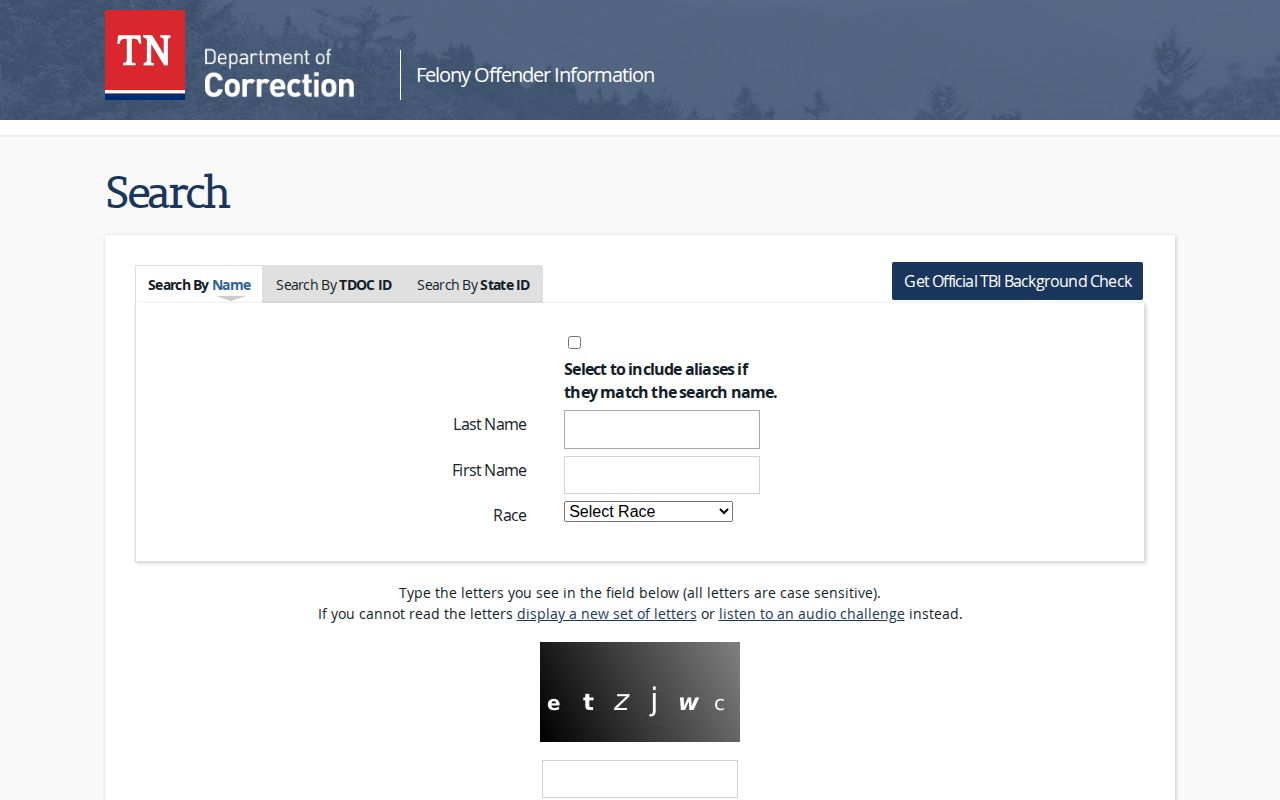
The form starts the match; the selected record's exact date labels determine what the result actually means.
FOIL may show a photograph, status, location, sentence data, hearing status, and release information. The exact panel varies. Quote what it says. Do not rename RED, sentence expiration, a hearing date, and a projected date as though they were one field. The Morgan County release-record search path explains how the jail and court records fit together.
Morgan Release Credit Calculations
Tennessee has no single safe formula for every sentence. TDOC begins with the offense statute and date, the judgment, length of each sentence, whether terms run together or one after another, pretrial credit, release-eligibility class, earned and retained credits, discipline, parole action, holds, and expiration. Tenn. Code Ann. § 40-35-501 governs release eligibility, while § 41-21-236 governs sentence-reduction credits.
Credits are not a fixed entitlement. The TDOC offender handbook calls them a privilege and points to agency policy. They may be earned, withheld, lost, restored, capped, or barred for a particular sentence. A disciplinary violation can defer eligibility. Consecutive terms require the applicable ineligibility periods to be calculated and added. A corrected judgment or jail-credit entry can also change the result.
Local confinement calls for local records. For a state inmate serving in a county facility, Tennessee guidance describes the sheriff's duty to keep monthly credit records under § 41-21-236(d). For an ordinary Morgan County sentence, obtain the judgment, the recorded jail credit, and the actual MCSO release entry. No official Morgan-specific good-time policy was found, so no local rate should be assumed.
Note: Arrest date alone cannot establish the Morgan County release date because the judgment, credited time, holds, and custody path all matter.
Why Morgan Release Dates Change
A projected date can move without an error. It is a snapshot of the controlling calculation. Compare the old and new record by exact field name and lookup date, then ask the custodian for the underlying transaction when the change matters.
| Factor | Possible effect | Record to check |
|---|---|---|
| Earned or restored credit | May advance an eligible milestone where law permits | TDOC or jail credit record |
| Discipline or lost credit | May delay eligibility or projected release | Calculation and disciplinary record |
| Corrected judgment or jail credit | Can change the base calculation | Court judgment and computation |
| Consecutive sentence | Adds applicable periods before eligibility | Judgments and TDOC calculation |
| Parole action | Grant, denial, rescission, or revocation changes the path | Board order and TDOC status |
| Detainer or hold | Can send the person to another custodian rather than the community | Release transaction and destination |
| Administrative processing | Can delay the gate event after a decision | Actual release record |
A new location can mean a prison transfer, not release. “Inactive,” “parole,” “probation,” and “released” also carry distinct meanings. Read the full record rather than relying on a date taken out of context.
Morgan County's 85 Percent Question
The familiar claim that every Tennessee prisoner serves 85 percent is wrong. For specified offenses committed on or after July 1, 2022, subsection (bb) of § 40-35-501 requires 100 percent and does not let credits reduce the sentence. Subsection (cc) also starts at 100 percent, but satisfactory program credits may lower the percentage needed for parole eligibility by no more than 15 percentage points. That produces an 85 percent floor for that defined group, not a statewide rule.
The distinction is crucial. The subsection (cc) credit changes the point of parole eligibility. It does not simply rewrite sentence expiration. Other offense and date provisions use other rules, and specified felony sentences on or after July 1, 2024 have additional treatment under subsection (ff). The current statute, the offense date, and the entered judgment must be read together.
A percentage still does not predict the gate day. Eligibility allows consideration; the Board may deny parole. A grant can await a plan, conditions, or later processing. Ask TDOC for the official computation rather than applying 85 percent to the sentence shown in a news report.
Morgan Jail and MCCX Dates
Morgan County Jail and Morgan County Correctional Complex are separate systems. The jail holds people tied to local arrests, pretrial cases, short terms, and transfers. MCCX is a state prison for TDOC prisoners who may have been convicted anywhere in Tennessee. A search for a “Morgan County inmate” can therefore return the wrong custody system.
For the jail, MCSO's corrections page confirms that officers keep a record of every person admitted or released. Ask for the named admission/release entry, release disposition, and destination. Pair it with the Morgan County court judgment or order. For MCCX, begin with FOIL and follow a disputed computation through TDOC records. A move from MCCX to another prison is not release.
The jail register and the court file answer related but separate questions. The register supplies the operational release date recorded by the jail. The judgment, bond order, dismissal, or amended order explains legal authority. Movement records can show a transfer that a one-line disposition leaves unclear. When the expected day passes without a community exit, ask whether another case, detainer, or receiving agency controlled the next step. A court order on one docket cannot be read as release from every hold.
Brushy Mountain is closed. TDOC states that the MCCX expansion led to its closure. Historical projected or actual release questions tied to Brushy Mountain require TDOC or archive records, not contact with the present tourist site.
Morgan Release Dates on Weekends
No authoritative source established a universal Tennessee rule that moves every weekend or holiday sentence release to Friday. Morgan County also publishes no local timing policy. Court orders, bond clearance, sentence computations, holds, and facility operations can produce different processing times. Do not promise a day or hour based on the calendar alone.
For a near-term county event, ask MCSO about the named person and the controlling order. For a state event, check FOIL, then ask TDOC whether the displayed date is eligibility, tentative release, or expiration. A receiving detainer can turn the expected community exit into an agency transfer.
Note: A projected Friday or weekend date remains unconfirmed until the releasing office records the completed event and destination.
Confirm Morgan County Release Dates
Tennessee VINE can provide a custody-change alert for TDOC and participating agencies, but Morgan County Jail participation must be checked in the live system. An alert reports the event supplied to VINE. It may not explain bond, time served, transfer, or a hold. Use the VINE Inmate Check as a prompt to verify, not as a certified discharge.
After an alert or projected date, recheck FOIL for a state prisoner. Ask TDOC for the actual release or discharge record when the public label is unclear. For a county-jail case, call MCSO and compare its release entry with the Circuit Court Clerk's order. Ask whether the person went to the community or another custodian.
For an older state record, TDOC's archived-record channel accepts a narrow request for a sentence-computation record, release certificate, discharge summary, and public supervision dates. Include the committed name, TDOC/TOMIS number if known, birth date, approximate facility and period, and the field in dispute. Archive-search charges may apply, and TDOC instructs requesters not to send payment before it gives notice. A county request should likewise identify existing records and seek an estimate before chargeable work begins.
Keep a dated copy of the result used for the prediction. When the later record differs, compare status, location, sentence alignment, credits, and release information before assuming an error. A past release date with continued supervision can be accurate, just as an expired prison term can be followed by another agency's custody. The operational record must identify the receiving authority if the person did not enter the community. That detail separates a completed release from one facility from an unconditional discharge from all control.
Completed release, end of custody, and final discharge can be different events. Parole, probation, and mandatory reentry supervision may continue after confinement ends. The final answer should identify the date, the authority, the destination, and any ongoing supervision.
Public Record Search
Sponsored Results